| 2010 in the Timewave |
|---|
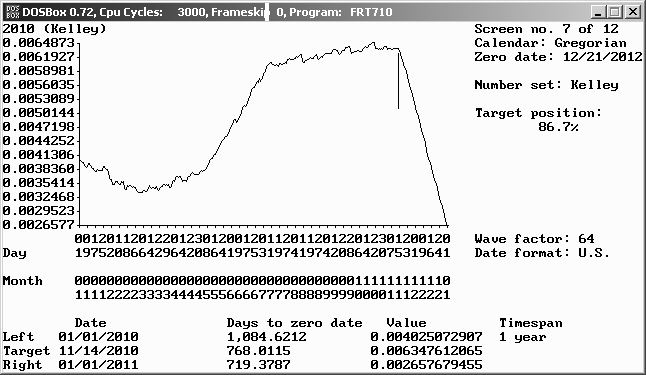
With the Kelley number set:
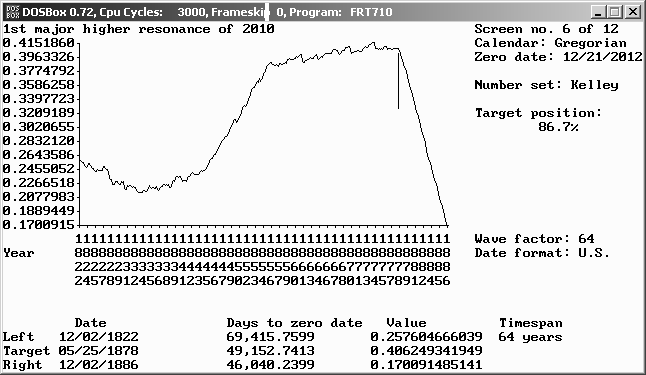
The first higher major resonance:
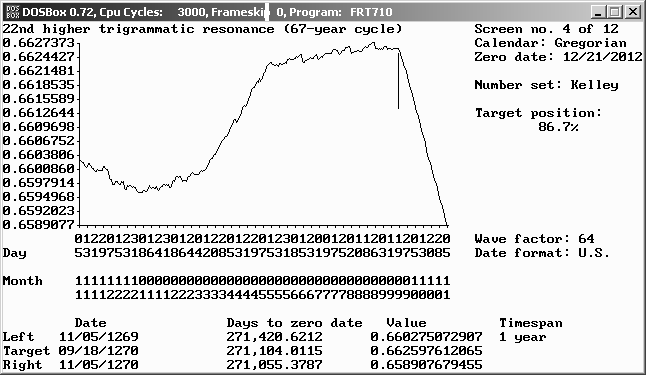
A trigrammatic resonance:
2010 with the Watkins number set (the Kelley number set without the "half-twist"):
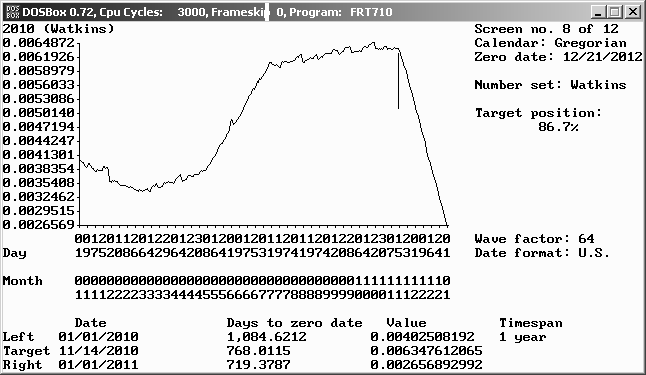
Very close to the Kelley timewave but not exactly the same.
2010 with the Sheliak number set:
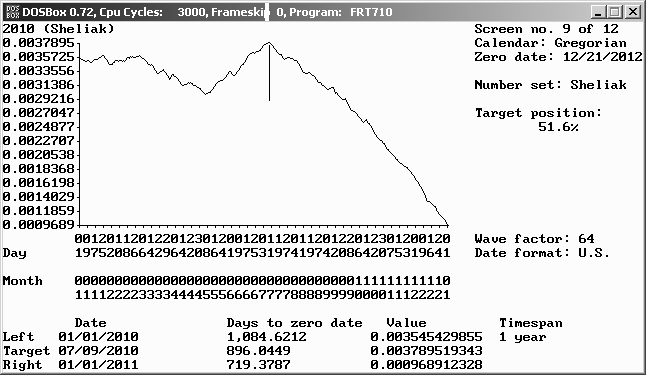
According to Terence McKenna major descents of the timewave are associated with an increase in "novelty" (or in the frequency of "novel" events). It is thus worth noting that from July through October 2010 nothing very novel occurred, in contrast to what the Sheliak timewave would lead us to expect. (In particular, the ecological disaster expected as a consequence of the Deepwater Horizon oilwell blow-out of April 20 did not occur — or probably more correctly, it occurred but was not reported in the mainstream media.) On the other hand, in November and December 2010 seriously novel events did occur (in accord with the Kelley/Watkins timewave), namely:
- the North Korean shelling of an island claimed and occupied by South Korea (which led the two countries to the brink of war, where in late December 2010 they remain) and
- the start of the release by Wikileaks of over 250,000 secret and confidential diplomatic cables between the U.S. State Department and U.S. embassies around the world (which, in the words of Israel Shamir, "throw a bright light upon the murky policies of the American Imperium, on their methods of collecting information, of delivering orders, of subverting politicians and robbing nations."
For more information about the Kelley number set and the Watkins number set see The Four Number Sets.
They may be reproduced elsewhere only if accompanied by
a link to this website: www.fractal-timewave.com
| 2011 in the Timewave | Home Page |